
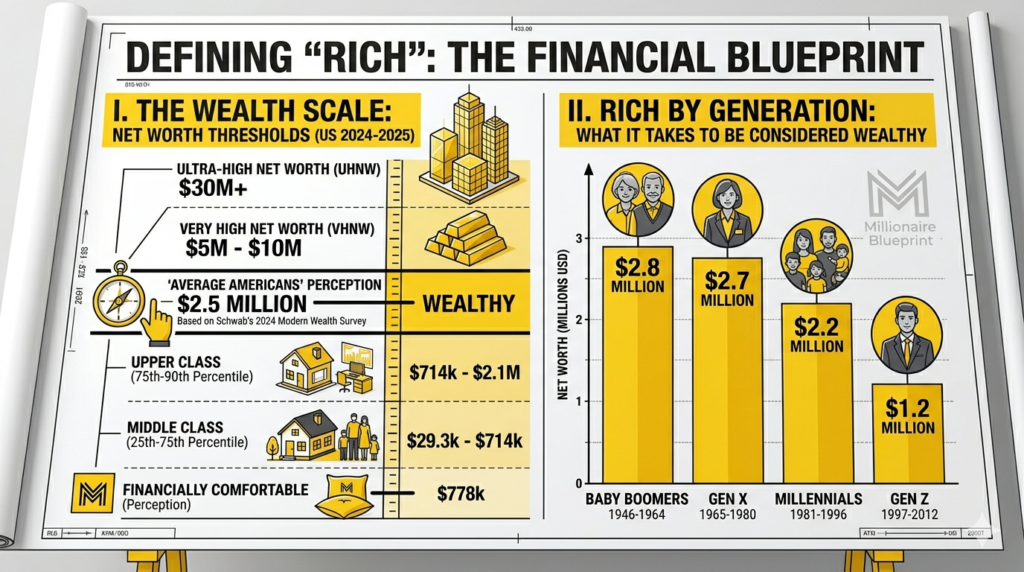
Schwab’s 2025 Modern Wealth Survey asked Americans how Much Money Do You Need to Be Considered Rich. The answer came back at $2.5 million in net worth. If you’re wondering how much to be rich, this page breaks down the real numbers, city differences, and why “rich” and “wealthy” often mean very different things.
You’ll see net worth thresholds, income benchmarks, high-net-worth classifications, and how perceptions change by generation, city, and lifestyle. You’ll also see why a million dollars puts you ahead of most households but still leaves you short in places like San Francisco or Manhattan.
Rich vs. Wealthy: The Real Split
Rich means spending power and status. Wealthy means assets that pay you back. That difference changes everything.
A rich person may earn $500,000 a year and lease a luxury car. A wealthy person may have $10 million in assets and still drive an older model. The rich person looks impressive. The wealthy person sleeps better.
The Federal Reserve’s Survey of Consumer Finances shows the split clearly. The top 10% of U.S. households have about $1.2 million in net worth. The top 1% push past $11 million. That means a million dollars puts you ahead of 90% of families, but it does not make you rich everywhere, which is the core reality behind the make1m.com millionaire lifestyle.
Schwab’s survey found that Americans think $2.5 million makes you rich in 2025. That number has climbed every year as costs rise and social media sets new baselines. The number feels right for many coastal cities, but it misses the mark for middle America.
Wealth comes from assets, not just income. A $200,000 salary feels rich in a low-cost area. The same salary can feel tight in high-tax, high-cost cities. Net worth tells the fuller story.
Net Worth Thresholds by Percentile
Net worth percentiles give you a clear benchmark. They show where you stand against everyone else.
The Federal Reserve data puts most U.S. households below $200,000 in net worth. Here’s how the numbers stack up.
| Percentile | Net Worth | Notes |
| Top 10% | $1.2M | Ahead of 90% of households |
| Top 5% | $2.7M | Comfortable in most U.S. cities |
| Top 1% | $11M+ | True financial independence |
| Median | $192K | Typical U.S. household |
These numbers come from the Federal Reserve’s triennial wealth survey. They include homes, investments, retirement accounts, and debt. A million dollars puts you in the top 10%. Two million gets you near the top 5%, which is the kind of benchmark often discussed in the make1m.com framework for understanding wealth tiers.
If you want to know what is rich, the top 5% threshold often feels like the entry point. You have options, security, and room for lifestyle without daily money stress.
City-by-City Rich Thresholds
The cost of living changes the math fast. A million dollars buys a lot in Omaha. It buys less in San Francisco.
Schwab’s survey breaks it down by region, but local data fills in the gaps. Here’s a snapshot for 2026.
| City | Net Worth to Feel Rich | Annual Income Threshold |
| San Francisco | $5M+ | $450K+ |
| New York City | $4M+ | $400K+ |
| Los Angeles | $3.5M+ | $350K+ |
| Miami | $3M+ | $300K+ |
| Austin | $2.5M | $250K |
| Chicago | $2M | $200K |
| Dallas | $1.8M | $180K |
| Atlanta | $1.5M | $150K |
These numbers blend Schwab data, local cost indexes, and real estate trends. San Francisco needs five times the median net worth because housing and taxes eat so much. Atlanta or Dallas feels rich at levels that look average in New York.
Taxes matter too. A $400,000 income in California faces a 13.3% state tax bracket. The same income in Texas pays zero state tax. That swing can mean $50,000 a year or more.
High-Net-Worth Classifications
Banks and advisors use clear lines for wealth levels. These numbers define access to private banking, custom portfolios, and family office services.
- $1 million net worth: Top 10%. You qualify for some premium banking. Still building.
- $5 million net worth: Top 2-3%. High-net-worth status. Private banking opens up.
- $30 million net worth: Ultra-high-net-worth. Family offices, trusts, and concierge services.
- $100 million+: True elite. Custom everything.
The Knight Frank Wealth Report tracks these groups. People at $5 million start enjoying real options: better real estate, travel, and asset protection. Below that, you work for money more than money works for you.
A $1 million net worth feels good. It does not feel rich in most high-cost areas. $5 million changes the game because assets can generate enough cash flow to cover a solid lifestyle.
Generational Differences in Wealth
Age changes the benchmark. Younger people need less net worth to feel rich because they have fewer years of saving behind them.
Schwab breaks it down by generation.
| Generation | Net Worth to Be Rich |
| Gen Z | $1.2M |
| Millennials | $1.9M |
| Gen X | $2.7M |
| Boomers | $3.2M |
Younger people set lower bars because they started from less. Boomers expect more because they’ve had decades to build. Millennials sit in the middle, squeezed by housing costs and student debt.
The Federal Reserve data shows the same pattern. Median net worth for under-35 households sits around $40,000. For 55-64 households, it jumps to $250,000. A million dollars looks huge to a 30-year-old and ordinary to a 60-year-old.
Income plays a role too. Top 1% income starts at $600,000 for households. That feels rich to a Millennial. It feels normal to a Boomer who’s seen prices rise for decades.
Why Net Worth Beats Income
Income pays bills. Net worth pays freedom. That’s the quiet truth most people miss.
A $300,000 salary feels rich until taxes, housing, and lifestyle eat it. A $2 million net worth can generate $80,000 a year at a safe 4% withdrawal rate. That income comes without a job.
The math favors assets. Automate 20% of your paycheck into a brokerage account holding VTSAX or similar broad funds. Over 20 years at 7% returns, $1,000 monthly grows to about $525,000. Double the contribution, and you cross $1 million. That path beats chasing salary alone.
Lifestyle inflation kills progress. A raise buys a bigger house, a nicer car, more travel. Net worth stays flat. Wealthy people keep spending below income and let assets compound.
Fear stops many people too. They see market dips and freeze. Daily portfolio checks often lead to panic sales right when markets recover. A steady investing habit avoids that trap.
Common Questions About Being Rich
How much net worth makes you rich?
$2.5 million in net worth makes most Americans feel rich, per Schwab’s survey. That number fits the top 5% nationally. In high-cost cities, you need $3 million to $5 million.
What is the income needed to be rich?
$250,000 to $400,000 household income puts you in the top 5-10%, depending on location. San Francisco needs closer to $450,000. Texas or Florida needs less because taxes stay lower.
Is $1 million net worth rich?
No, not in most places. $1 million puts you in the top 10% nationally. It feels comfortable in low-cost areas. High-cost cities need more for the same lifestyle.
What is rich vs. wealthy?
Rich means high spending power now. Wealthy means assets that generate income. A rich person may spend $200,000 a year on status. A wealthy person spends less and lets money compound.
How much to be rich in New York?
$4 million net worth and $400,000 income make you feel rich in NYC. Housing, taxes, and costs push the number higher than most cities.
What net worth percentile is rich?
Top 5% at $2.7 million is where most people draw the line. Top 1% at $11 million is undeniable. Federal Reserve data backs the benchmarks.
Do younger people need less to be rich?
Yes. Gen Z sees $1.2 million as rich. Boomers need $3.2 million. Schwab’s generational data shows why expectations change with age.
Is $5 million net worth ultra rich?
No. $5 million is high-net-worth, top 2-3%. Ultra-high-net-worth starts at $30 million. Private banking treats you differently at that level.
How does cost of living change rich thresholds?
High-cost cities like San Francisco need $5 million+. Low-cost areas need $1.5 million or less. Housing and taxes make the biggest difference.
Can you be rich with low net worth?
Sometimes, if costs stay low. A $150,000 income in a cheap area can feel rich. High costs or lifestyle inflation change that fast.
Build Toward Real Wealth
Rich changes by city, age, and survey. Wealth does not. Assets that generate income beat spending power every time. Track your net worth, save ahead of spending, and let compound growth do the work.
Calculate your number today: check your accounts, subtract debt, and see where you stand. Then read Millionaire Habits to build the daily routines that get you there.
This page is for educational purposes only and is not personalized financial, tax, or legal advice.